
 |
| Click to read article |
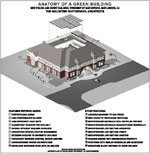 |
| Police
& Court Building Maplewood, NJ (click to enlarge) |
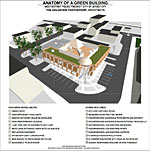 |
| Police
Precinct Building Jersey City, NJ (click to enlarge) |
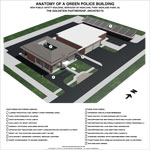 |
| Police and Fire Building Highland Park, NJ (click to enlarge) |
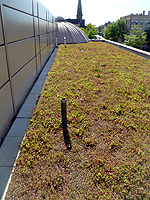 |
| Green Roof: West District Jersey CIty |
 |
| Police
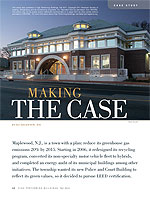
& Court Building Maplewood, NJ |
Decades before the term “green building” even existed, we at The Goldstein Partnership were utilizing materials and strategies to conserve energy and other natural resources.
Our clients recognized and continue to recognize that such measures pay for themselves in numerous ways, from smaller heating plants to larger percentages of usable space, and from reduced utility bills to enhanced occupant comfort.
For us, sustainability is an attitude that informs virtually every design decision. While LEED and other such rating systems are useful, our approach goes far beyond them, to address issues like building form and cross-sectional efficiency.
The Goldstein Partnership was utilizing materials and strategies to conserve energy and other natural resources decades before the term “green building” existed.
For us, sustainability has always been an attitude that informs virtually every design decision. While LEED and other such rating systems are useful, our approach goes far beyond them, addressing additional significant issues like building form and cross-sectional efficiency.
Our leadership in sustainable building design is exemplified by the fact that our Maplewood Police & Court Building is the first LEED-certified municipal building of any type in the State of New Jersey (LEED Silver). Eli Goldstein, AIA, PP, LEED served on the Technical Committee advising the Rutgers Center for Green Building on the development of the New Jersey Green Building Manual, issued in 2011.
| "The Goldstein Partnership was able to integrate environmentally responsible building principles seamlessly into its design. As a result, our new Police and Court Building will be the first of its type in the State to be LEED Certified, giving Maplewood yet another public building to be proud of." | |
| - Fred R. Profeta, Jr., Mayor, Township of Maplewood, NJ |
| "Leveraging their extensive experience in the design of green buildings, Mr. Goldstein's team figured out how to significantly reduce the building's overall heating and cooling loads, despite increasing the overall building size." | |
| - Adam Hubeny, Borough Administrator, Atlantic Highlands |
|
||||||||||||||
|
LEED/GREEN BUILDINGS | SHARED SERVICES | PUBLIC BUILDINGS | EXPERT SERVICES
DISASTER RECOVERY | RECREATION | RELIGIOUS | EDUCATION
MEDICAL/HEALTH CARE | SPECIALIZED CORPORATE | LABORATORIES | RESIDENTIAL
PUBLICATIONS | ABOUT THE FIRM | CONTACT US | EMPLOYMENT | HOME